

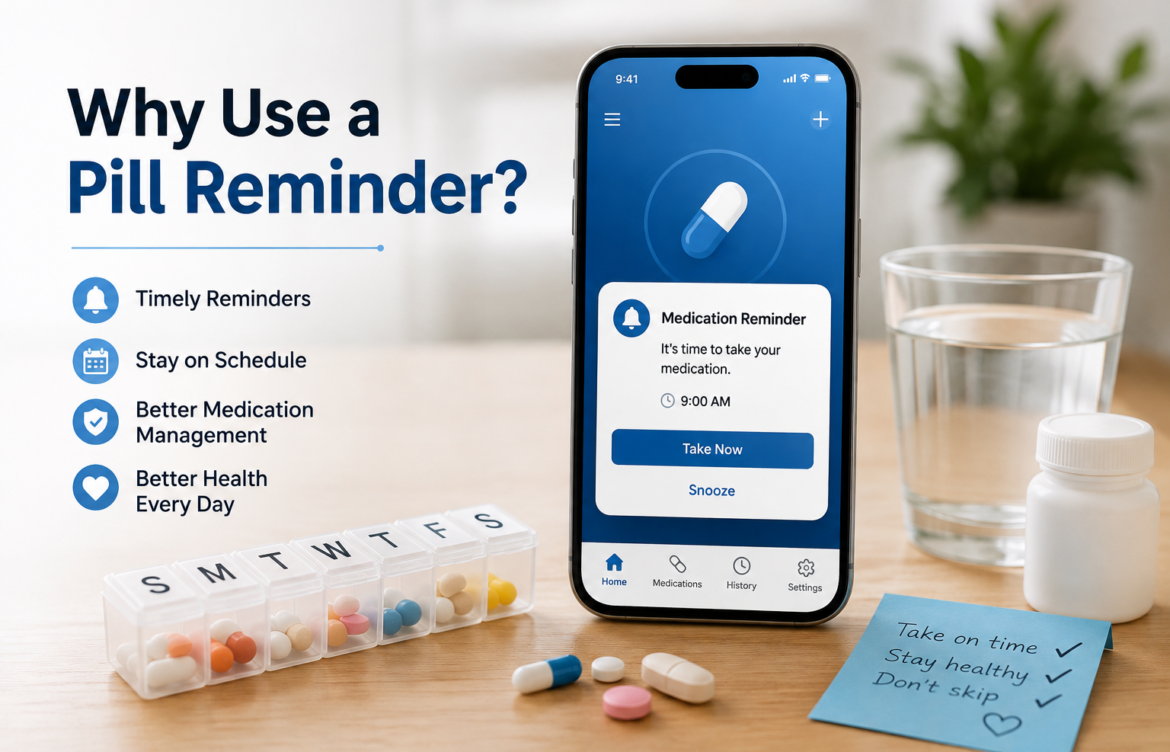
Why Use a Pill Reminder? 7 Benefits for Better Medication Management
Taking multiple medications at different times gets messy fast. Work gets in the way. Travel throws you off. Routines shift around. You just forget. A pill reminder cuts through all that noise by sending you alerts when doses are due. Keep your schedule straight.
People on long-term prescriptions need this stuff. Same goes for anyone juggling supplements or multiple daily meds. Caregivers benefit too, tracking someone else’s routine without the headache. Digital reminders live on your phone and other devices you already have. Access your schedule whenever you need it.
None of this replaces what your doctor told you. It’s not medical advice. What it does do is help you stick to the schedule your healthcare provider gave you. Build a solid routine around it.
What Are the Benefits of a Pill Reminder?
A pill reminder helps you organize your medication schedules and get prompts when doses are coming up. You get a bunch of benefits from using one.
- You won’t forget to take pills.
- Multiple medications become way easier to track.
- Routines stay consistent.
- Dose schedules are simpler to review.
- Caregivers can monitor what you’re taking.
- Travel doesn’t mess up your routine.
- Everything sits in one place instead of scattered around.
If you manage medications regularly, having a structured reminder system makes your everyday routines way simpler to handle.
1. Helps Reduce Missed Medication Times
Reminder systems do one thing really well: they ping you when it’s time to take your meds.
Life gets messy. Meetings pop up. Kids need something. School deadlines hit. You’re traveling. A thousand things pull your attention away. You might want to take your medication on time, but something interrupts and boom, you skip a dose.
A digital reminder cuts through that noise. It brings your focus back to what you’re supposed to be doing.
Instead of trusting your brain to remember, you build a routine around those notifications. They become your backup.
But here’s the thing. Reminders aren’t permission to mess with your medication schedule. How much you take, when you take it, how often you take it – that all comes from your doctor. Nothing changes without their say-so.
2. Makes Multiple Medications Easier to Organize
Handling a single medication seems simple but managing multiple prescriptions creates a more complex daily routine.
People must handle various medical treatments which require them to take different medications.
- In the morning
- Around lunchtime
- In the evening
- Before bedtime
- On specific days
The reminder system establishes a single organized schedule by combining all these individual schedules into one system.
The system helps users forget about individual medication schedules because it shows them their complete daily schedule in an easy-to-understand format.
Users can detect possible confusion through a properly organized medication list before it develops into an actual problem.
3. Supports a Consistent Daily Routine
Consistency can make everyday medication management easier.
When alerts happen at set moments, ingesting drugs may link to fixed daily segments, including morning meals, midday food, evening repasts, or sleep time if suitable per written orders.
As time passes, such prompts may integrate into one’s habitual daily schedule.
Maintaining a regular timetable can prove particularly beneficial for individuals managing hectic schedules or those whose routines shift often throughout each day.
The key issue involves utilizing alerts based on prescribed directions instead of autonomously choosing administration times.
4. Makes Medication Tracking More Convenient
Recalling when you need to consume your prescribed drugs represents merely a single component involved in managing those medicines effectively. Maintaining records regarding various types of drugs alongside their specific timetables and daily habits may similarly prove difficult over time.
Digital reminder instruments may offer one main spot for pertinent data.
Depending upon which system is utilized, individuals might possess the capability to arrange specifics including:
- Medication names
- Scheduled times
- Daily frequency
- Reminder notifications
- Personal notes
- Medication routines
Keeping such data arranged makes daily administration feel less complex.
It may likewise prove beneficial during preparations for talks with medical practitioners, though drug details ought to remain cross-checked against up-to-date orders and expert guidance.
5. Can Help Caregivers Stay Organized
Taking medication is not always done solely by the individual consuming it; parents, relatives, and care providers might assist with organizing timetables as well.
Such a reminder system might help arrange those duties with greater ease.
For those providing care, an organized framework might assist in recalling when a specific individual requires medication oversight. Such utility becomes evident when handling numerous day-to-day obligations simultaneously.
Nevertheless, digital storage of medication data requires constant attention to both privacy and account security.
Providers ought likewise to prevent altering medication amounts or timing plans except when directed by the relevant medical expert.
6. Makes Travel and Busy Days Easier to Manage
Travel can disrupt normal routines.
Shifts in where one lives, when they sleep, what jobs they hold, and how their days run can cause people to miss taking medicine on time.
A computerized network may assist individuals in keeping their timetables orderly when they are distant from residence.
Prior to departure, individuals ought likewise verify drug necessities, preservation states, renewal demands, and scheduling directions with their medical practitioner or pharmacy technician if required.
A prompt serves as aid, yet readiness stays a key element of secure drug handling.
7. Encourages More Organized Medication Habits
Perhaps the biggest long- One primary advantage offered by reminder systems involves improved organization. Instead of relying solely upon recall capabilities, individuals may construct a consistent routine centered upon their prescribed drug timetable.
A simple routine might involve:
- Adding the medication information correctly.
- Setting reminders according to professional instructions.
- Reviewing the day’s schedule.
- Responding to reminders at the appropriate time.
- Checking the schedule regularly for accuracy.
This method may render drug administration seem less daunting.
It remains vital to refresh alert details each time a clinician alters a drug, dosage, or timetable.
What Should You Look for in a Medication Reminder?
Not every reminder tool offers the same features. When choosing a digital solution, consider whether it provides the functions that match your routine.
Useful Features May Include:
| Feature | Why It Matters |
| Custom reminders | Helps accommodate different schedules |
| Multiple medications | Useful for complex routines |
| Simple interface | Makes daily use easier |
| Schedule management | Keeps medication information organized |
| Mobile access | Allows reminders while away from home |
| Recurring notifications | Supports regular routines |
| Easy editing | Helps update changed schedules |
The most useful tool is generally one that is simple enough to use consistently.
Why Digital Medication Reminders Are Becoming More Popular
People now use their modern smartphones to manage their daily activities after these devices became available to the public. People now include calendars and alarms and fitness applications and productivity tools as essential elements of their daily activities.
The system operates like medication reminder technology which uses digital tools to provide users with additional tracking features.
People find mobile-friendly platforms most useful because they carry their smartphones with them during all their daily activities. Users can check their schedules through digital accessibility because they don’t need to bring physical documents or remember everything by heart.
How Pill Reminder Can Simplify Daily Medication Management
Pill Reminder is designed around the basic need to keep medication schedules organized and accessible.
A straightforward digital approach to managing medication can help users to set up reminders, manage their routines, and receive reminders at set times.
For individuals who are managing daily tasks on their smartphone, a standalone app for tracking of and reminders for medication is an easy to use alternative to setting off multiple alarms.
Pill Reminder apps can be helpful tools but should not replace medical guidance and advice.
Important Safety Considerations
Medication reminders are organizational tools and not medical decision-making systems.
Users should:
- Follow their prescribed medication instructions.
- Never change a dose because of a reminder.
- Do not take double the amount of medication for missed doses unless specifically instructed by a healthcare provider to do so.
- Confirm unclear instructions with a pharmacist or doctor.
- Keep medication information updated.
- Store medicines according to their instructions.
- Seek professional help when experiencing concerning reactions.
What to do if you miss a dose of medicine depends on the medicine. Talk to your pharmacist or healthcare provider for the proper response.
Conclusion
A pill reminder is important to manage medicines. Organizing schedules for important medications instead of relying on memory is easier. Timely reminders, simple management of multiple schedules, support of routines and daily organization – all in one pill reminder.
Digital reminder technology can be especially useful for people with very busy lives, for example for caregivers or for people on many medications and with complex medication schedules. These can be organized into a routine using a tool such as Pill Reminder.
For the best experience with a pill reminder, remember that it is just a part of a complete system of managing your medications and that careful management of your medications is required to ensure that the best use is made of your medications.
Frequently Asked Questions
What is a pill reminder?
A pill reminder is a tool or application that helps users remember scheduled medication times through notifications or other prompts.
Can a pill reminder help prevent missed doses?
It can give an additional reminder for the time when the medicine is supposed to be taken, and thus help prevent that it gets forgotten. However, it does not guarantee that the dose is going to be taken.
Can I use a reminder for multiple medications?
Most reminder systems are able to handle multiple medications and different times for each one.
Should I change my medication schedule based on an app?
No, a reminder app should only help you remember your medication in accordance with a health care professional’s schedule for you.
Is a digital reminder useful for caregivers?
Yes. A reminder system for example can be structured in a way to help the caregiver of the person with the medical condition.
Can I use medication reminders while traveling?
Reminders while traveling can be useful to stay on track with your medication. It is however also wise to bring your medication, check if any travel restrictions apply to your medication and to check with your doctor if any special action is required while traveling abroad.