

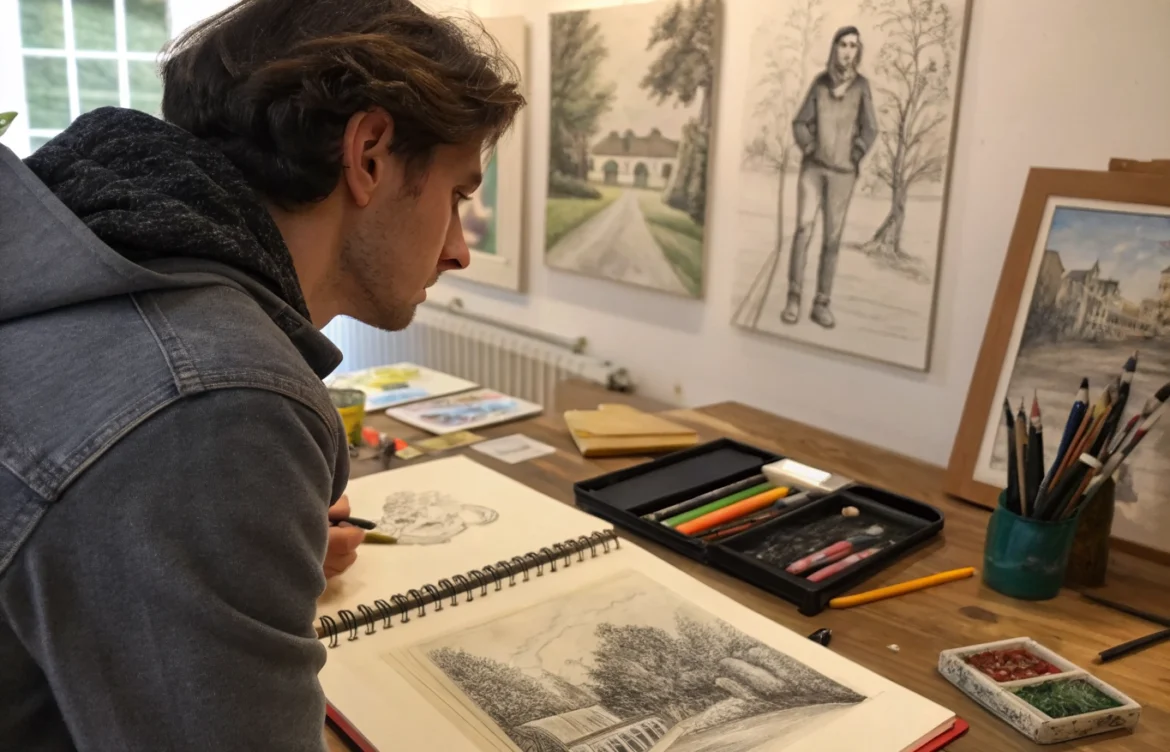
Realistic Sketching: A Complete Guide to Mastering Pencil Art
Drawing is really satisfying because it lets artists show emotions and small details using a pencil and paper. Realistic Sketching is a method that stands out because it can create subjects that look real and have a lot of depth. You can see the difference away when you use Realistic Sketching.Whether you’re sketching portraits, landscapes or, just plain ordinary things it takes patience and practice to get it right, and honestly it can feel like a long road. Every artist begins with basic shapes, then adds small details bit by bit, until the whole drawing looks kind of alive, like it’s breathing. It is also important to get the light, shadows and proportions or the whole picture will look wrong.Observation is a part of drawing. Artists should study their subjects carefully before drawing them. Looking at proportions measuring angles and comparing distances can help artists create accurate drawings. Daily practice can help artists develop their observation skills and become better at drawing.Accurate proportions are essential for creating drawings. Measuring relationships between parts of a subject can help artists maintain consistency. Perspective is also important for adding that weird sense of depth in a drawing. Like you have to understand the horizon line, and the vanishing points, plus the whole foreshortening thing. If an artist gets how those pieces work together, the final image tends to look more realistic, not just kinda flat.

Understanding the Principles of Realistic Drawing
Natural talent can help,.It is honestly not the biggest deal. What matters more is actually being committed to learning, and to practice it consistently , even on days when you feel slow. When artists take that time to study and then keep practicing, they start to notice progress, bit by bit. This guide is really about the mindset behind Realistic Drawing, not just the final look. It can support beginners, and also artists with a bit more experience who want sharper skills or smoother outcomes, you know. Before you dive into drawing, it helps a lot to grasp the basics of realistic drawing. Basically, almost everything can be broken down into easy forms, like circles cubes and spheres.. Once you do that, proportions become easier to handle. Also observation is a real artist skill because it helps you see what is actually there , not just what you think is there. Light and shadow are elements of artwork. Every object absorbs light differently, so you get highlights , midtones, and also shadows. An artist should watch how the light kind of drops onto objects, and then use that whole idea to build drawings. Outlining objects with lines is not as important as showing how the values change.Texture and fine details can bring drawings to life. Different materials have textures and reflect light in different ways. Artists should establish value patterns before adding finer textures. Patience is important when adding textures and fine details as rushing can result in drawings that look messy.

Selecting the Right Materials
Artists should really look at the objects they want to draw, then analyze each angle, each edge, and each shadow too. And don’t ignore the surrounding space, because that too improves accuracy .With steady practice, coordinating hands and eyes starts to feel more natural, and like you’re not constantly thinking about it. Confidence grows, the fear of “getting it wrong” fades, kind of gradually, and then suddenly it feels almost easy. Still, many beginners get discouraged , because they expect their drawings to be perfect immediately. Realistic Drawing takes time and repetition to get to a place that feels right.Mastering pencil techniques is important for getting results. Different grades of graphite pencils can create effects. Softer pencils are better at creating values, while harder pencils can make lighter lines, kind of like they are more restrained.So an artist kind of should test different pressure levels, and various layering ways to land on the exact mood or effect. Usually it takes a little bit of trial-and-error, because the same pencil can behave differently depending on how you grip it, and also how many passes you end up doing.

Building Strong Observation Skills
Many beginners make mistakes that can slow their progress. Focusing on details before establishing proportions can lead to corrections later. Pressing hard on the paper can make it difficult to make adjustments without damaging the paper. Overblending can also reduce contrast. Remove important textures.Building confidence through learning is important for artists. Practicing regularly even if it is just, for a minutes a day can help artists see significant progress over time. Studying master artists participating in drawing challenges and maintaining sketching habits can encourage improvement.Realistic drawing is a journey that combines observation, technical knowledge and practice. Success depends on developing foundations in proportion, perspective, lighting, shading, texture and observation. Artists who remain patient and consistently refine their skills can achieve results. Every sketch contributes to confidence and a deeper understanding of art. With dedication and the right mindset anyone can develop the skills to create compelling pencil artwork that captures realism.